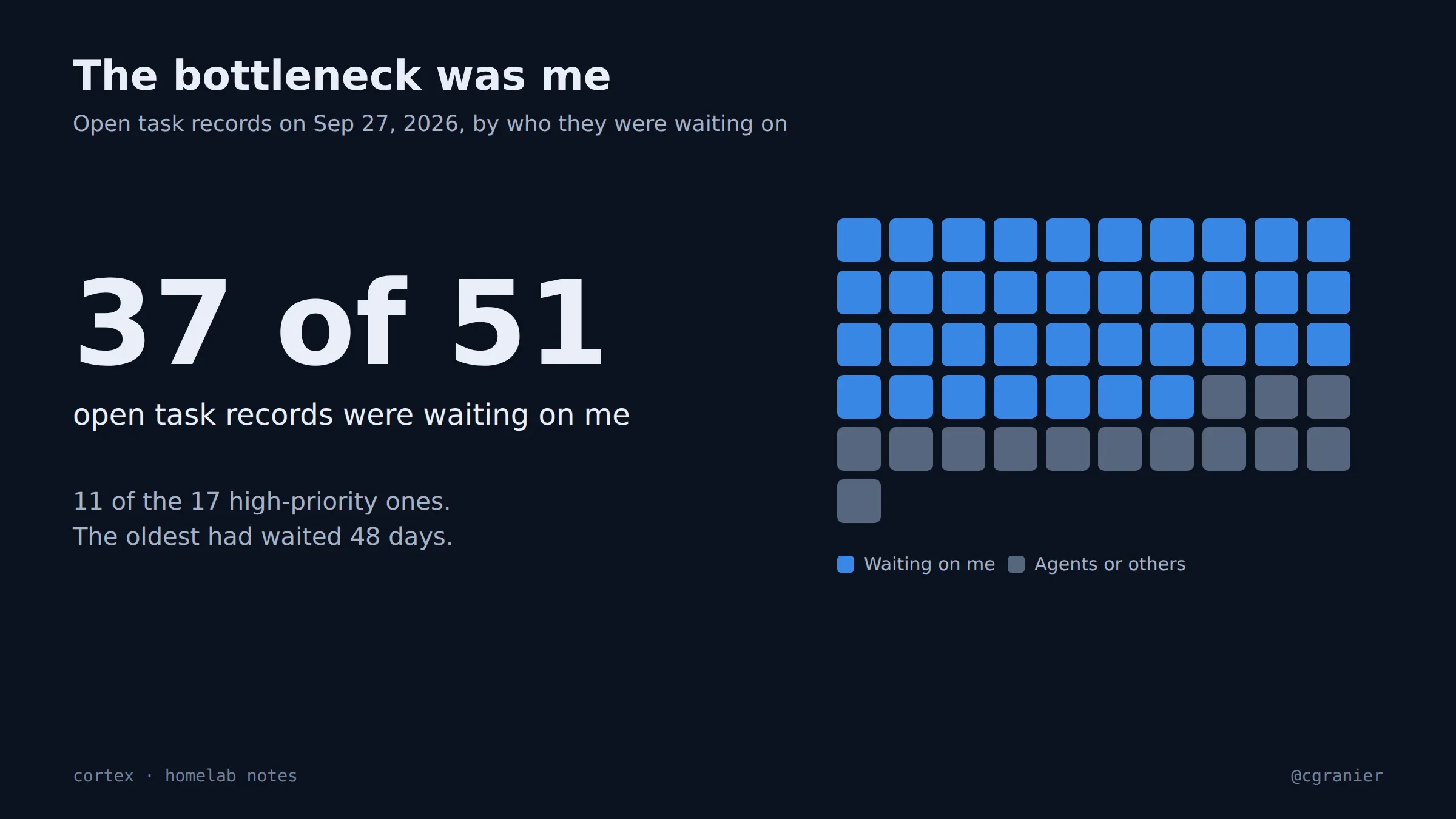
The short version: I run my projects with AI agents and assumed they were the slow part. On September 27 I counted: 37 of 51 open tasks were waiting on me, including 11 of the 17 high-priority ones. One had waited 48 days. So I built a way to make decisions faster instead of adding agents.
Get the week's seven in one email, every Monday.
What went wrong
Every unit of work in my setup is a small task record with an owner, a status and a next step. Agents pick up their own records; mine wait for me.
I kept thinking about how to get more out of the agents. Then I counted where the work was actually stuck. Most of it was stuck on me: approvals, choices, “should we do this at all”. An overnight agent that proposes work had suggested the same one-line fix on 15 of 16 nights. The agent wasn’t slow. My decision was.
What we learned
- Measure where your queue waits before you add capacity. With agents, the queue that needs the most attention is often the one with your name on it.
- A report-only agent moves the bottleneck to you. If the same proposal comes back night after night, you have a decision problem, not a compute problem.
- Decisions need their own interface. Mine were scattered across chats, notes and records, so none of them felt urgent.
What went right
I built a decision desk: one Telegram card at a time on my phone, with buttons for approve, proceed, decide, defer, kill and skip. Every answer goes into a ledger of what was proposed and what I decided. The first walk-through took about six hours and cleared 41 decisions. 41% of them were skips, which is useful information too.
How to do it (as of October 2026)
- Count open work by owner, and by owner among the high-priority items. Do it before you build anything.
- Put decisions in one place you’ll actually open, one at a time.
- Log each proposal next to the decision. Over time, that ledger shows which kinds of work you always approve, and so which you could let run on their own.
- Make “skip” mean “later”, not “show me again right now”. My first version brought skipped cards straight back.
- Sort by priority before “someone is waiting”. Mine briefly put a minutes-old normal task above a 25-day-old urgent one.
Status
Still true. On October 12, 52 of my 97 open tasks were waiting on me. The desk helps when I use it; using it more often is the open part.