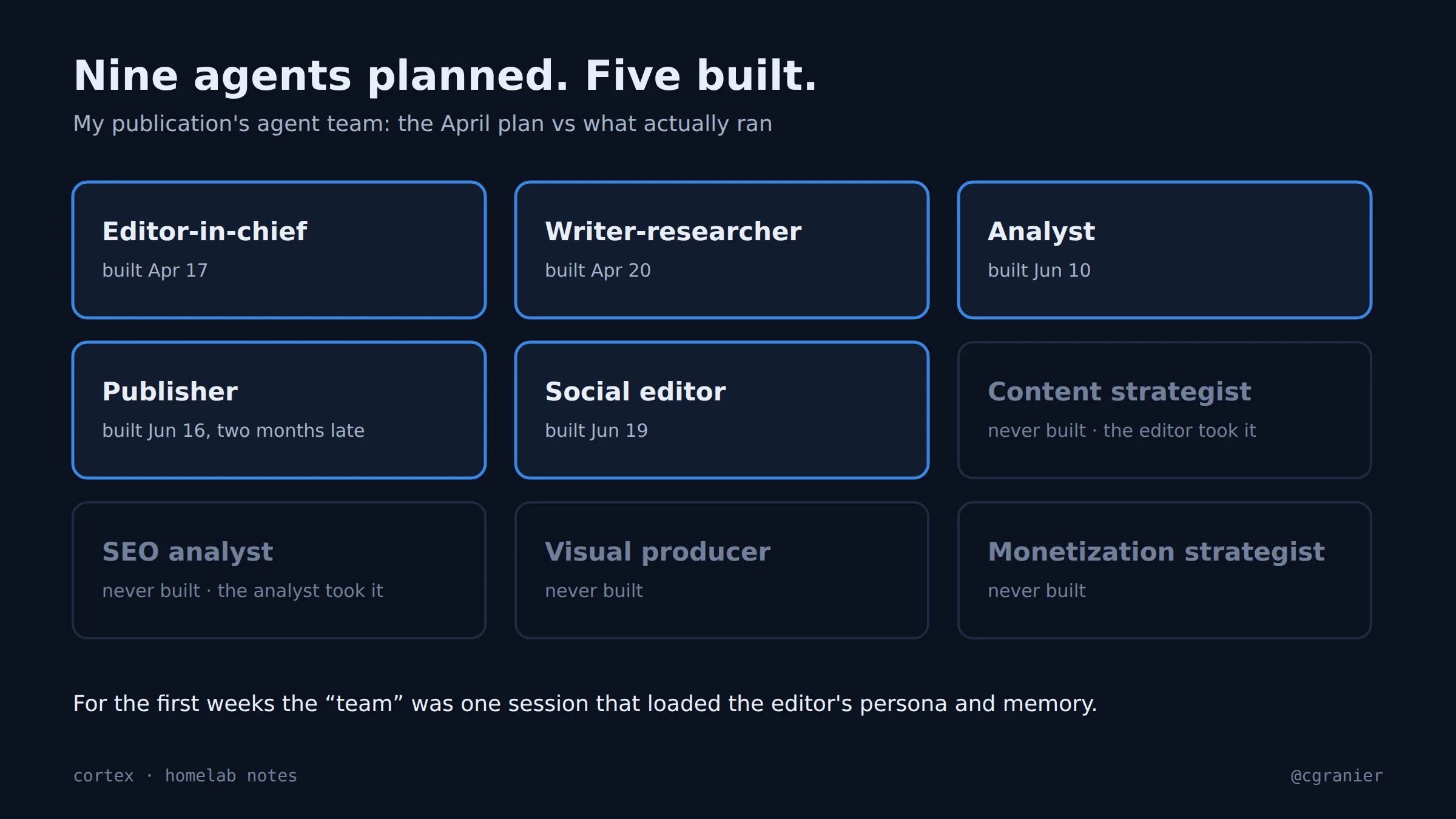
The short version: in April I wrote an operating manual for a publication run by a team of nine AI agents. Five were ever built. For the first weeks the “team” was one Claude session that loaded the editor-in-chief’s persona and memory and became the editor. Real delegation only arrived where a task could run on its own and produce something I could check.
Get the week's seven in one email, every Monday.
What went wrong
The plan had nine roles across four phases: an editor-in-chief, a writer-researcher, a publisher, a social editor, an analyst, a content strategist, an SEO analyst, a visual producer and a monetization strategist.
In practice I worked with one session at a time, and that session loaded the editor’s persona and became the editor. The editor’s own first memory note said it plainly: “the only agent on disk… Don’t pretend to delegate.” When the writer agent finally got its first assignment, it did 78 tool calls of research, twice, and couldn’t save a word, because a leftover settings file in a nested folder overrode its permissions. For several weeks the editor drafted the weekly roundups itself, because that was easier.
What we learned
- Most “multi-agent” setups are one session wearing hats. That’s fine. Say so, and design for it.
- An agent earns its place when a task can run headless with a checkable output. The writer became real when it drafted on a schedule and produced a file I could review. The roles with no such task never needed to exist.
- Unbuilt roles get absorbed. The editor took over strategy; the analyst took over SEO. Nobody missed the separate agents.
What went right
The five roles that shipped each had a concrete job, a schedule and an output: a draft, a published page, a batch of posts, a report. In two weeks of June, the jobs running unattended went from 4 to 13.
How to do it (as of October 2026)
- Start with one persona, loaded into whatever session you’re in.
- Add an agent only when a task can run without you and leaves an artifact you can check.
- Keep each role’s memory as a versioned file in the repo, not in a tool’s private memory.
- Every month or so, check which roles actually did work. Fold the rest back in.
Status
Still true. The publication runs on those five roles today.