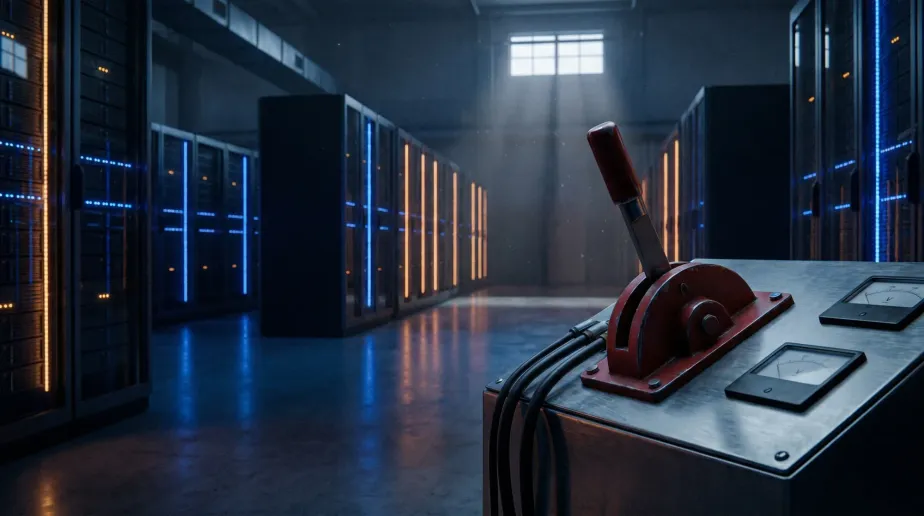
At 5:21pm ET on a Friday, a federal export-control directive switched off the two best AI models in the world. Fable 5 and Mythos 5 went dark for every foreign national on Earth, including Anthropic’s own foreign-national employees, three days after launch. The legal hook was national security. The cited evidence was a single narrow jailbreak: ask the model to read a codebase and fix its flaws, a thing defenders do every day on every frontier model. Anthropic complied, and said so under protest. The line to keep is theirs: “If this standard was applied across the industry, we believe it would essentially halt all new model deployments for all frontier model providers.”
The switch worked for a reason that has nothing to do with the jailbreak. It worked because Fable was a service. One API, one company, one place the state could put its hand. A model served from a data center is a faucet, and the order simply told Anthropic to close it. The capability never left Anthropic’s machines. The leverage was the plumbing.
A service has a switch. A file doesn’t.
A model that ships as open weights is not a faucet. It’s a file: inert until it runs, trivial to copy, impossible to recall once it lives on enough disks. There is no API to revoke, no company to command, no single point to pressure. awrigh01 named this best in the essay that turned the suspension into a thesis: “Closed AI gives the state a switch, and open weights take that switch away, which is why the fight over open models will turn vicious.”
The state’s leverage over a frontier capability has an expiration date. It’s set by the moment that capability stops being a service and becomes a download.
The legal machinery is already built
“Code is speech” used to function as a password. It doesn’t anymore. In Defense Distributed v. Attorney General New Jersey, decided February 12, 2026, the Third Circuit held that purely functional code with no expressive purpose “is simply not covered by the First Amendment,” and that whether any given file earns protection takes “a fact-based and context-specific analysis.” The case is about 3D-printed gun files. The doctrine travels. Model weights are the maximally functional artifact: a file whose entire value is what it does when executed, not what it says.
The export side is staged too. The Biden BIS “Framework for Artificial Intelligence Diffusion,” issued January 2025, explicitly reached closed-source model weights. The Trump administration rescinded it before it took effect, but the impulse outlived the rule, and the impulse is what matters: monitor first, restrict later. Add the DeepSeek panic, a bill to keep it off government devices, and a House committee report, and the playbook is sitting on the shelf waiting for the next file worth fighting over.
The danger is real. That’s not the argument.
Concede it plainly, because it’s true. RAND has warned about uplift toward biological weapons. Anthropic runs ASL-3 safeguards on this exact concern and built costly 30-day data retention to study the jailbreaks it admits it can’t fully prevent. Nobody serious thinks frontier models are toys.
The question was never whether the capability is dangerous. It’s who holds the off switch, and what stops them from using it for something other than bioweapons. A closed system hands the state, and anyone who can lean on the state, a control surface the user never sees and can’t audit. Open weights don’t make the danger disappear. They preserve exit, and exit is the thing that disciplines power.
So the synthesis isn’t “let everything run free.” It’s govern conduct and deployment, not the artifact. Put the duty on the hospital, the lender, the DNA-synthesis vendor: the deployer who can actually cause the harm. Not on the person who published a file. Regulate the harm, not the file.
One week, three altitudes, one fear
The same fear of concentration fired at three altitudes at once, in three vocabularies that don’t usually talk to each other.
The state proved access can be revoked. That’s the kill switch, and it’s no longer hypothetical.
At the desk, the advice circulating was to download local weights as insurance. A new local coding model dropped days later, and the framing around it was blunt: keep runnable weights offline, because “free API access won’t necessarily last forever … Don’t wait until you need it.” The format in question is GGUF: a model packaged to run on a laptop, no cloud. “Exit disciplines power” becomes, at the level of one developer and one laptop, have the GGUF on disk.
In the boardroom, Satya Nadella argued the same week that the goal has to be a frontier ecosystem, not just a frontier model, because a world where “all the value is accrued by only a few models” is one “the political economy will simply not tolerate.” Name the interest before someone names it for you: Nadella runs Microsoft, OpenAI’s largest backer, so “don’t let a few models eat all the value” is a competitive position as much as a civic one. It’s still the same fear. Open weights, local insurance, token capital: three names for the worry that intelligence concentrates into a few hands that can be commanded.
Why this isn’t the EFF version
The civil-liberties case for open weights is decades old. It runs straight out of the crypto wars, and I’m not going to rewrite it. What’s new is that open-versus-closed stopped being only a rights question and became a structural variable in the buildout itself.
If you track AI infrastructure as an investment — the power, the optical, the GPU cloud, the data-center capex I write about every quarter — the open/closed split changes who captures the returns and where the durable margin sits. If you run models locally, the way I run a stack on my own hardware, it changes whether your tools survive a directive issued at 5:21 on a Friday. The architecture question has two faces and one answer to find: open enough that institutions can own and inspect the intelligence they depend on, or closed enough that only governments and hyperscalers decide what it does. That’s the civic stake and the investable one, and they point the same way.
The kill switch wasn’t the crisis. It was the demonstration. Sit with awrigh01’s line, because the mechanism it describes never feels like force when it arrives: “The permissioned path does not arrive as tyranny. It arrives as convenience.”
About the Author
Carlos Granier is a Tech Founder, CTO, and AI Strategist with 25 years of experience building at the intersection of technology and business. He co-founded Pongalo, one of the first US Hispanic OTT platforms, and built a YouTube MCN to 200M+ monthly views. He now helps founders and executives implement AI as practical infrastructure. Based in Miami, Florida.
Let's Connect
If you want to hire me or get in touch about something or just to say hi, reach out on social media or send me an email.
- X (Twitter) /
- Threads /
- Instagram /
- GitHub /
- LinkedIn / 📧